Reading the book, The Standard Bookshelf, Great Philosophers by S.E. Frost Jr., I came across the authors view of Hobbes in his Chapter Man and the State
pg. 216.
Frost writes,
"The materialist, Thomas Hobbes, based his theory of the state upon the fundamental principle that man has the natural right to do anything which he pleases. The most primitive urge of all men is that of self-preservation. To accomplish this end, man may use any means he deems necessary. In this state of nature man may invade the rights of others with the result that chaos reigns"
In this assessment of Hobbesian theory, any man can and will violate the very basic rights of another for their own gain and this is to be seen as a natural state of man. In this theory, a man who wishes to obtain land or wealth simply must be stronger than those that he wishes to obtain them from. By that it stands to reason that what Hobbes describes as rights are in fact only permissible actions or objects, since any man can come along and take them away. In a way, we live in that Hobbesian world now.
The next paragraph, "Man is, then, fundamentally a ferocious animal, one who engages in war and pillage, seeking always his own gain. But in such a state no man can be strong enough to preserve himself for long. Each man will destroy the others and he in turn will be destroyed by others."
In this part of the theory all actions are seen to only benefit the one at the expense of all others. The author makes it clear that in the Hobbesian model all men are expendable to the strongest other and in the end it shall be the strongest that survives and thrives until another rises to be stronger still.
He continues, "Thus, to escape from this inevitable end, man creates a society in which he voluntarily gives up his rights in many matters. This is a contract which men make with each other by which they give up certain rights in order to obtain others which they desire. To insure this mutual contract, men transfer power to one ruler or an assembly. After the ruler has been set up and given power, the men must obey."
The creation of "society" is done by the mergence of all interactions and individual actions of all living beings in any geographical area. What the author is trying to establish is Hobbes' inclination to the voting of given power, but then negates that by establishing the subjecting class of individual to obey this ruler. The inherent fault of modern voting is that even those that do not wish for that particular ruler or any rulers at all are subjected to the will of the majority because of some cosmic happenstance of geographical location relative to others. If one objects to those rulers or rulers in the general sense they are vilified and accused of "Utopian Idealism". The author charges that Hobbes was a monarchist, trying to defend the right and rule of the King of England. He made his theory to fit a mold of this belief.
Later in this dissection of Hobbesian theory Frost writes, "Hobbes recognizes, that at times the ruler will be unjust and will wreak hardships upon men. But they have no right to rebel. Hobbes justifies this position by holding that even at their worst, the injustices of a ruler are never so bad as the original state of man before power was given to the ruler."
This is the mindset of those minarchist, monarchist, communists, socialists and all other forms of rule against individual secession and anarchy. Those that can give up their rights, and in turn the rights of others, for the gain of rule over them and given no form or function to remove these self locked chains are the sort this world is full of at the moment.
This theory is obvious in its practice today in our modern world. Its adherence is cast into all young people through mandatory hours of subjection to state made educational programs. This theory is not one that recognizes the inherent natural rights of man but rather forms them to be basic, aggressive and completely arbitrary to the will of the strongest man around. In nature the theory of " the strongest survive" is given leeway to man's ultimate desire without the least inclination to the fundamental rights of others. It is a theory of "you have right to what you can take and what you can keep, and you have a right to elect those that will take for you, but have no right to reduce or refuse that elected power". Seems pretty counterintuitive to a wholly moral philosophy in my personal opinion.
John Locke, philosopher, had a very different idea of the rights of man. I will detail this authors writings of Locke in a later post.
Follow The Jefferson Papers on Facebook.
Or you can follow me on Twitter.
Showing posts with label libertarianism. Show all posts
Showing posts with label libertarianism. Show all posts
Wednesday, September 10, 2014

Tuesday, August 19, 2014
Radio Show I did over the Weekend.
I was asked to come onto a radio show by the host and talk about the blog and about other things, current news, a bit into the economics of police and the increasing militarization of police forces across the country as well as subsidies and the alter effects of taxation. It is a short 30 minute show and the host and I were able to get through a lot of topics and issues.
Take a minute to listen to a spot I did with Rakkur Crowley on his radio program Austrian Circle. You can find his entire playlist on the Voluntary Virtues Network Youtube channel.
https://s3.amazonaws.com/AustrianCircle/Podcasts/Austrian+Circle+Travis+Wilson+web.mp3
Take a minute to listen to a spot I did with Rakkur Crowley on his radio program Austrian Circle. You can find his entire playlist on the Voluntary Virtues Network Youtube channel.
https://s3.amazonaws.com/AustrianCircle/Podcasts/Austrian+Circle+Travis+Wilson+web.mp3
Monday, June 9, 2014
Brutalism As A Trend
As many in the Libertarian circles and liberty movement general groups are aware there is a stir growing around an article by Jeffrey Tucker. His article, "Against Libertarian Brutalism",Tucker tried to explain the thought of what he calls the brutalist, or for me better labeled the coarse libertarian. These coarse and abrasive libertarians, explains Tucker, are drawn to the ability "to assert their individual preferences, to form homogeneous tribes, to work out their biases in action, to ostracize people based on “politically incorrect” standards, to hate to their heart’s content so long as no violence is used as a means, to shout down people based on their demographics or political opinions, to be openly racist and sexist, to exclude and isolate and be generally malcontent with modernity, and to reject civil standards of values and etiquette in favor of antisocial norms." As I read the article I had my ideas of who this could be directed at or who at least fit the description and the various reasons why I could see a quick and unrelenting response from the person. Sure enough, within an hour of reading the article there was a response, and from none other than who I felt the original post defined well.
While I do not agree with the severing of the small group of libertarians, I can see where Tucker was coming from. The language and demeanor of the now self gratifying and self identifying Brutalists is something I had noticed before, but shrugged it off as just a way for someone to express themselves.Though it is not the way I would do things or even a way I see as beneficial to advancing the case of liberty. Even if I don't agree with the ways in which someone wishes to be, I have no power to stop them from doing as they see fit.
Jeffrey Tucker compared this nature of people to an architectural style used from the 1950's through the 1970's. "Brutalism asserted that a building should be no more and no less than what it is supposed to be in order to fulfill its function. It asserted the right to be ugly, which is precisely why the style was most popular among governments around the world, and why brutalist forms are today seen as eyesores all over the world." What Tucker says here is important, and mostly missed by the responses I have read into since its publication. It is seen that the right to be crude or abrasive is inherent in the rights of all men, but it does not do well in the stand of time, what is seen today as form or function will later be seen as an eyesore or impediment to the advancement to an idea. An idea of individual freedom should not hinge on a case to be offensive just for the sake of being offensive and then to justify the behavior by stating you have the freedom to do so. Of course the freedom to say and do things is a natural right of all people, and of course the right to be offended is in there too. One note that I did take from a lot of the responses to this article is the assumption that Tucker would want to somehow limit or restrict the ability to being a brutalist, I could not find one mention of this idea in any of words he has written on the subject. He even says in his article,"Thus do the brutalists assert the right to be racist, the right to be a misogynist, the right to hate Jews or foreigners, the right to ignore civil standards of social engagement, the right to be uncivilized, to be rude and crude. It is all permissible and even meritorious because embracing what is awful can constitute a kind of test. After all, what is liberty if not the right to be a boor?" Yes you do have a right to be the way you are and are even encouraged to be this way; for what is freedom but the inner most expressions of oneself to the world without the restrictions or regulations of outside forces?
In order to build a city many styles will be used; some used out of necessity, some out of function, some even for subjective beauty. This is an important idea in the building of any city, while what may seem as an eyesore in the later years, or in the present seen as a style without style, so to speak, still contributes the basis for the idea of that city, it performs a function of being a vessel inside whatever environment it inhabits. The houses and building in any city vary from one another and each has its own value attached by those in and around those structures. Just as in the Humanitarian Vs. Brutalist argument, these two styles will naturally draw and dispel certain people to its respective ranks. As time goes on we will see the effects of what we do and say to other in the progression of this idea of Liberty we all hold dear.
In all the conversations about this topic there is a clear dividing line, and this is the worst of what is happening in my opinion. Instead of being able to work together for the common goal there has come this divide in sections of the same general groups. Mending this gap, I don't think is possible at this time. But we hold hope that together we can move past the smallest details and work for that common end. Individual Liberty.
A friend of mine on Facebook stated it wonderfully.
Say you are to buy a car. Would you want the sales person to come at you with an attitude, to belittle and offend you? Or would you be more receptive to the offers given if the salesperson has a pleasant attitude and disposition? For me this signifies the greatest belief in the good of people and the good that people can bestow upon others. Just because you have the freedom to be brutal doesn't mean you have to be. Selling the idea of liberty and freedom does far more for those that see it in the most positive ways and can again present it in a most positive way.
I hold no discontent or judgement against those that view themselves as the Brutalists, and I hold no higher esteem or reverence for those who identify as the Humanitarians. I see everyone as the individual they are and the many different things they bring into my life and the surrounding environments we both enjoy.
Monday, May 5, 2014
Rights Violations Aren’t The Only Bads
The following article was written by Sheldon Richman and published at The Future of Freedom Foundation, January 17, 2014.
More than a few libertarians appear to hold the view that only rights violations are wrong, bad, and deserving of moral condemnation. If an act does not entail the initiation of force, so goes this attitude, we can have nothing critical to say about it.
On its face, this is strange. If you observe an adult being rude to his elderly mother, it is surely reasonable for you to be appalled, even though the offender did not use force. And, being appalled, you may be justified under the circumstances in responding, such as by cancelling a social engagement or telling others of his obnoxious behavior. One can reasonably say that this person’s mother is owed better treatment, without the word owed implying legal, that is, coercive, enforceability. (Words can have different senses, of course.) Therefore, the rude son may be judged culpable.
This example may be uncontroversial, but observe the attitude in another context. I recently argued that “intellectual property” (IP) can’t really be property (as can land, cars, and socks) and that it is, rather, a government grant of monopoly power over expressions of ideas, which perforce limits other people in the use of their property, while creating scarcities where there would have been none.
The article brought vigorous critical responses, one of which informed me that if I don’t believe that expressions of ideas can be owned, I would have no right to object if someone were to plagiarize or adulterate my written work.
Before diving in, I’d like to draw attention to the strange habit IP proponents have of bringing up plagiarism (or adulteration) as soon as the legitimacy of copyright is challenged. This is strange because so-called copyright infringement per se differs in a crucial respect from plagiarism. The publishing industry doesn’t strenuously lobby the government for fortified copyright laws because it is worried I will publish Atlas Shrugged with my name on the cover. (Who’d buy it?) On the contrary, it worries that I (or someone else) will publish the novel with Ayn Rand’s nameon the cover. Copyright and plagiarism must be considered apart from each other.
Be that as it may, the premise of my critic’s claim — that I cannot logically object to plagiarism or adulteration because I don’t believe expressions of ideas can be owned — must be that theonly legitimate ground for objection would be that these activities are property violations. So if they are not property violations, there is no basis to complain.
With all due respect, this is ridiculous. One who rejects the legitimacy of intellectual property can still have perfectly good moral grounds for objecting to the plagiarist’s or adulterator’s misconduct. Libertarians ought to think long and hard before buying the idea that rights violations are the only species of wrongful conduct.
If someone attaches his name to something I wrote, the plagiarist’s declaration that he is not a thief (because expressions of ideas cannot be owned) is hardly germane. I would not accuse him of being a thief. Rather, I’d accuse him of being a fake — of pretending to have accomplished something he in fact did not accomplish. Likewise, the adulterator is not a thief, but a fraud who misrepresents what he sells. Both are to be held in contempt for they have violated Kant’s maxim to treat each person “never merely as a means to an end, but always at the same time as an end.” Their assertions that they are not thieves are as relevant as a burglar’s assertion that he is not a murderer.
Slight digression: Metaphor pervades all language. When one says that a copyright infringer “stole” from an author or publisher, one cannot mean this literally (no pun intended), for what was actually stolen? We can easily imagine an “infringement” that entails no physical violation whatsoever. IP has the impossible premise that an author or publisher owns a Platonic form of a work, which is embodied in, yet transcends, every physical instantiation of that work, even those owned by other people. In other words, you can buy a book, but you cannot buy the book. The anti-IP response is that abstractions cannot be owned.
The upshot is that a rejecter of IP may justly take offense at the plagiarism or adulteration of his work and expose the fakes and scoundrels. “The same mechanisms that make copying easy make plagiarism very difficult,” Karl Fogel writes in “The Surprising History of Copyright and The Promise of a Post-Copyright World.”
I should add that customers may justly claim they are victims of fraud. On what grounds? On the same grounds that any fraud victim has: The buyers were tricked into entering transactions on terms other than those they would have agreed to. The remedy might come through a class-action suit, the award being a refund plus costs. (Context is crucial. Someone who buys a $10 Rolex on the streets of Manhattan probably cannot credibly claim that he thought he was buying a genuine Rolex.)
What I’m arguing for is a commonsense category of noninvasive moral offenses, wrongful acts that do not involve force. Since force plays no part, the remedies must not entail force (state-backed or otherwise) either. But forced-backed remedies are not the only — or even the best — remedies available. Nonviolent responses, including boycotts, shunning, and gossip, can be highly effective.
Libertarians ought to beware of embracing such a narrow view of morality that only forceful invasions of persons and property are deserving of moral outrage and response. Think of all the cruel ways people can treat others without lifting a hand. Are we to remain silent in the face of such abuse?
The erroneous belief that only conduct for which a coercive response is appropriate — that is, rights violations — may be condemned leads too easily to the corollary error that if some conduct is deserving of condemnation, it must somehow be a rights violation. The initiation of force is not the only bad thing in the world.
Also found at Center for a Stateless Society
Tuesday, April 29, 2014
Florida Sheriffs and the fight against Marijuana
Florida will be the next battleground for the Medical
Marijuana issue to surface. In 2014 voters will have the opportunity to voice
their opinions on the matter; this has also given the state’s law enforcement
brigades a reason to form an alliance to combat this issue. Elected Sheriffs from all across the state are
teaming up to write articles in local papers, performing community outreach
projects and citizen awareness campaigns on what they see as the dangers to
society if medical marijuana were to be legalized or at a very least
decriminalized. What I am here to say is
“Sheriffs, Shut up already”.
If it is to be said that Law enforcement is the part of any
government that’s sole reason for existence is to enforce the laws, ticket,
fine or apprehend and incarcerate law breakers, then it should matter not what
the laws are. As a collective of elected officials that swear to uphold the
states laws and codes there should be no comment from this group as it would be
in their special interest that any substance and product be illegal. In line
with the most common defense of their actions, “just doing their jobs”, this
would mean that groups of elected sheriffs and officers should not try to
influence the changing of these laws by activism or advocacy campaigns.
The
Florida Sheriffs Association cites multiple reasons why they oppose these
reform measures. Most of these reasons are for the belief in the order to
protect the common good or public welfare. Other reasons given by law
enforcement are the reports of rising crime rates in areas where marijuana is
legalized or decriminalized. Some of these reports are false and others
unsupported, but that’s no reason to throw out the results say officers. “Florida’s
sheriffs believe that legalizing smoking marijuana, which has no accepted
medical use and a high potential for abuse, is a dangerous decision for our
state and its citizens. Florida’s Sheriffs stand firm in their opposition to
the legalization of the use, possession, cultivation, delivery and sale of
marijuana”, Says their website.
The Association also puts in a disclaimer, “Florida sheriffs
agree that there may be strains of marijuana that can provide relief for
children with severe, intractable seizures.
This type of marijuana is high in CBD, a pain relieving and
anti-convulsing component of marijuana, and contains minimal amounts of
tetrahydrocannabinol (the psychoactive ingredient that produces a high). Sheriffs are concerned about manipulation of
families in need if the production, distribution, monitoring and quality
control are not well defined and regulated.” This is an example of exclusionary
or discretionary liberty. When a group or groups are permitted while others are
punished for the same act it does not send a clear message as to the reason for
the ban in the first place. If the health risks are too great for recreational
use by non-sick people than it stands that the health risk would be the same
for sick persons. If the safety and security of the community be the reason it
stands that the Association would define all crimes as being committed by those
who do not suffer from these diseases. Though no study has been done to find
this I would bet there would be at least some crime being committed by those
that would be accepted to use medical marijuana.
On another side of this issue is the group Law Enforcement Against Prohibition (LEAP). LEAP
is a group of law enforcement personnel that oppose not only the prohibition of
marijuana but of all recognized drugs and substances. Their statement is, “History
has shown that drug prohibition reduces neither use nor abuse. After a rapist
is arrested, there are fewer rapes. After a drug dealer is arrested, however,
neither the supply nor the demand for drugs is seriously changed. The arrest
merely creates a job opening for an endless stream of drug entrepreneurs who
will take huge risks for the sake of the enormous profits created by
prohibition. Prohibition costs taxpayers tens of billions of dollars every
year, yet 40 years and some 40 million arrests later, drugs are cheaper, more
potent and far more widely used than at the beginning of this futile crusade.”
This is a different view in that instead of police punishing users, seller,
buyers, cooks, growers and producers the riddance of prohibition will lead to
more crimes of violence or property theft and damage. LEAP believes in a system
of regulation and distribution but doesn’t mention who would have this control.
This is an area I would like more details to be released.
One more way to look at this issue is the idea of complete
abolition of all laws and regulations on every substance, natural plant or drug
that is currently under the control of government. This belief is one that
reduces the issue down to the basic aspect of property rights and self-ownership.
If every man be respected to own and use his property in any way that does not
interfere in the rights of others this issue is resolved under this ultimate
idea. We do not live in such a world though. We live in a world where what a
man does in his own home to his own body by voluntary means has somehow
directed an effect unto the entirety of the public and should be shunned and
punished by captivity.
The idea of self-governance and self-ownership is lost on
the majority of the public. It is a concept that takes away the power to
dictate others actions and set prejudices against things or situations that
they morally admonish or oppose and replace it with responsibility for one’s own self and nothing
more.
The War on Drugs is ultimately a war on freedom and choice.
It is a war on individual liberty and self-ownership. It is the opposition to
the freedom that many people claim they seek and many more claim they support.
The War on drugs is in one sentence a War on People.
Friday, April 4, 2014
Florida Liberty Summit - Jack Hunter.
Florida Liberty Summit
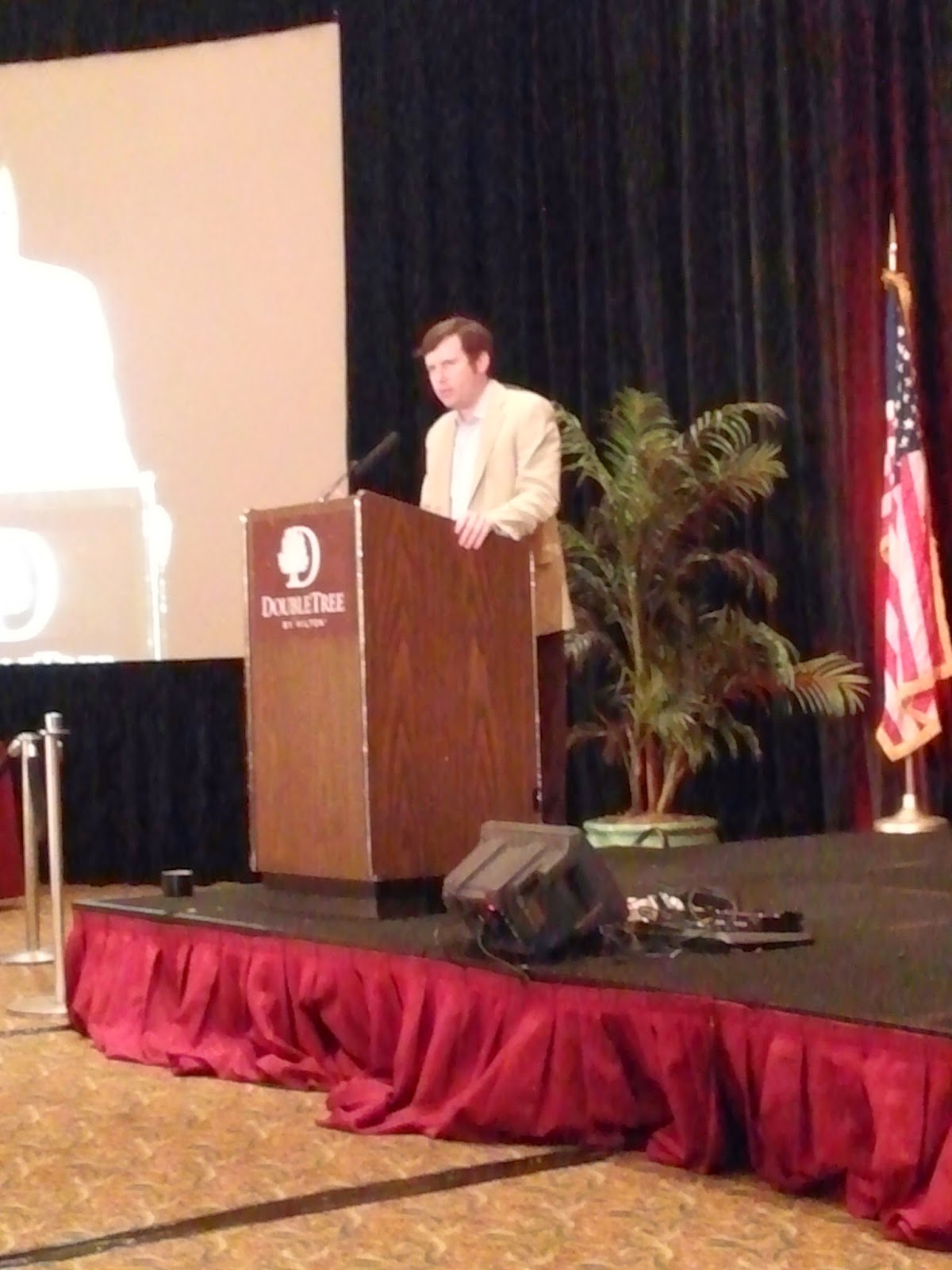
Jack Hunter, known to some as The Southern Avenger, gave a
speech breaking down CPAC 2014 and talking about his views on what he calls The Future of Liberty – Part 1.
At CPAC Mike Huckabee gave a statement that the Republican
Party is increasingly becoming more Libertarian, and Mr. Hunter says, “Thank
God for that!”
Giving notes on The Goldwater Era alongside the Reagan Era,
the Philosophy of the Bush Dynasty.
On Goldwater, Jack states there is a thought that America
was not ready for the hard hitting and extremely deep cutting ideas of Barry
Goldwater in 1965. I would absolutely agree on this fact.
“Those Damn Goldwater
people are everywhere.”
Jack is a dedicated supporter of Libertarian ideals and of
Ron Paul, the figurative mast head of the liberty and libertarian movement. He
gives an idea that as Libertarianism, the philosophy not the party, the more
the establishment Republican Party has to fear.
“The old guard of the
Republican Party is clueless to the rising of Libertarians.”
Wednesday, March 26, 2014
Anarchist, Libertarian or Voluntarist: Why I use one word over another.
I have been thinking about the meaning of these words and of their reaction in society lately. There seems to me to be a very large majority of people who have a negative connotation to two of them and not so much knowledge of the last. So it is here that I will begin.
What Anarchy is and what it is not.
What Anarchy is and what it is not.
The vast majority of the public will react negatively to the use of the word anarchy. Through false description and definition imposed on them through government run schools and reinforced by media and social entertainment they have been lead to believe that only bad things could happen in a world with no government. Thunder Dome would become reality in their minds. Would it really though, would they allow that to happen in their presence, would everyone just go around murdering and looting?
Thursday, March 13, 2014
Charles Lindbergh was a Non-Interventionist on foreign policy.
Charles Lindbergh was a Non Interventionist when it came to the foreign policy of the United States. This is a transcript of a speech he gave in Des Moines Iowa on September 11th 1941.
"It is now two years since this latest European war began. From that day in September, 1939, until the present moment, there has been an over-increasing effort to force the United States into the conflict.
That effort has been carried on by foreign interests, and by a small minority of our own people; but it has been so successful that, today, our country stands on the verge of war.
At this time, as the war is about to enter its third winter, it seems appropriate to review the circumstances that have led us to our present position. Why are we on the verge of war? Was it necessary for us to become so deeply involved? Who is responsible for changing our national policy from one of neutrality and independence to one of entanglement in European affairs?
Personally, I believe there is no better argument against our intervention than a study of the causes and developments of the present war. I have often said that if the true facts and issues were placed before the American people, there would be no danger of our involvement.
Here, I would like to point out to you a fundamental difference between the groups who advocate foreign war, and those who believe in an independent destiny for America.
If you will look back over the record, you will find that those of us who oppose intervention have constantly tried to clarify facts and issues; while the interventionists have tried to hide facts and confuse issues.
We ask you to read what we said last month, last year, and even before the war began. Our record is open and clear, and we are proud of it.
We have not led you on by subterfuge and propaganda. We have not resorted to steps short of anything, in order to take the American people where they did not want to go.
What we said before the elections, we say [illegible] and again, and again today. And we will not tell you tomorrow that it was just campaign oratory. Have you ever heard an interventionist, or a British agent, or a member of the administration in Washington ask you to go back and study a record of what they have said since the war started? Are their self-styled defenders of democracy willing to put the issue of war to a vote of our people? Do you find these crusaders for foreign freedom of speech, or the removal of censorship here in our own country?
The subterfuge and propaganda that exists in our country is obvious on every side. Tonight, I shall try to pierce through a portion of it, to the naked facts which lie beneath.
When this war started in Europe, it was clear that the American people were solidly opposed to entering it. Why shouldn't we be? We had the best defensive position in the world; we had a tradition of independence from Europe; and the one time we did take part in a European war left European problems unsolved, and debts to America unpaid.
National polls showed that when England and France declared war on Germany, in 1939, less than 10 percent of our population favored a similar course for America. But there were various groups of people, here and abroad, whose interests and beliefs necessitated the involvement of the United States in the war. I shall point out some of these groups tonight, and outline their methods of procedure. In doing this, I must speak with the utmost frankness, for in order to counteract their efforts, we must know exactly who they are.
The three most important groups who have been pressing this country toward war are the British, the Jewish and the Roosevelt administration.
Behind these groups, but of lesser importance, are a number of capitalists, Anglophiles, and intellectuals who believe that the future of mankind depends upon the domination of the British empire. Add to these the Communistic groups who were opposed to intervention until a few weeks ago, and I believe I have named the major war agitators in this country.
I am speaking here only of war agitators, not of those sincere but misguided men and women who, confused by misinformation and frightened by propaganda, follow the lead of the war agitators.
As I have said, these war agitators comprise only a small minority of our people; but they control a tremendous influence. Against the determination of the American people to stay out of war, they have marshaled the power of their propaganda, their money, their patronage.
Let us consider these groups, one at a time.
First, the British: It is obvious and perfectly understandable that Great Britain wants the United States in the war on her side. England is now in a desperate position. Her population is not large enough and her armies are not strong enough to invade the continent of Europe and win the war she declared against Germany.
Her geographical position is such that she cannot win the war by the use of aviation alone, regardless of how many planes we send her. Even if America entered the war, it is improbable that the Allied armies could invade Europe and overwhelm the Axis powers. But one thing is certain. If England can draw this country into the war, she can shift to our shoulders a large portion of the responsibility for waging it and for paying its cost.
As you all know, we were left with the debts of the last European war; and unless we are more cautious in the future than we have been in the past, we will be left with the debts of the present case. If it were not for her hope that she can make us responsible for the war financially, as well as militarily, I believe England would have negotiated a peace in Europe many months ago, and be better off for doing so.
England has devoted, and will continue to devote every effort to get us into the war. We know that she spent huge sums of money in this country during the last war in order to involve us. Englishmen have written books about the cleverness of its use.
We know that England is spending great sums of money for propaganda in America during the present war. If we were Englishmen, we would do the same. But our interest is first in America; and as Americans, it is essential for us to realize the effort that British interests are making to draw us into their war.
The second major group I mentioned is the Jewish.
It is not difficult to understand why Jewish people desire the overthrow of Nazi Germany. The persecution they suffered in Germany would be sufficient to make bitter enemies of any race.
No person with a sense of the dignity of mankind can condone the persecution of the Jewish race in Germany. But no person of honesty and vision can look on their pro-war policy here today without seeing the dangers involved in such a policy both for us and for them. Instead of agitating for war, the Jewish groups in this country should be opposing it in every possible way for they will be among the first to feel its consequences.
Tolerance is a virtue that depends upon peace and strength. History shows that it cannot survive war and devastations. A few far-sighted Jewish people realize this and stand opposed to intervention. But the majority still do not.
Their greatest danger to this country lies in their large ownership and influence in our motion pictures, our press, our radio and our government.
I am not attacking either the Jewish or the British people. Both races, I admire. But I am saying that the leaders of both the British and the Jewish races, for reasons which are as understandable from their viewpoint as they are inadvisable from ours, for reasons which are not American, wish to involve us in the war.
We cannot blame them for looking out for what they believe to be their own interests, but we also must look out for ours. We cannot allow the natural passions and prejudices of other peoples to lead our country to destruction.
The Roosevelt administration is the third powerful group which has been carrying this country toward war. Its members have used the war emergency to obtain a third presidential term for the first time in American history. They have used the war to add unlimited billions to a debt which was already the highest we have ever known. And they have just used the war to justify the restriction of congressional power, and the assumption of dictatorial procedures on the part of the president and his appointees.
The power of the Roosevelt administration depends upon the maintenance of a wartime emergency. The prestige of the Roosevelt administration depends upon the success of Great Britain to whom the president attached his political future at a time when most people thought that England and France would easily win the war. The danger of the Roosevelt administration lies in its subterfuge. While its members have promised us peace, they have led us to war heedless of the platform upon which they were elected.
In selecting these three groups as the major agitators for war, I have included only those whose support is essential to the war party. If any one of these groups--the British, the Jewish, or the administration--stops agitating for war, I believe there will be little danger of our involvement.
I do not believe that any two of them are powerful enough to carry this country to war without the support of the third. And to these three, as I have said, all other war groups are of secondary importance.
When hostilities commenced in Europe, in 1939, it was realized by these groups that the American people had no intention of entering the war. They knew it would be worse than useless to ask us for a declaration of war at that time. But they believed that this country could be entered into the war in very much the same way we were entered into the last one.
They planned: first, to prepare the United States for foreign war under the guise of American defense; second, to involve us in the war, step by step, without our realization; third, to create a series of incidents which would force us into the actual conflict. These plans were of course, to be covered and assisted by the full power of their propaganda.
Our theaters soon became filled with plays portraying the glory of war. Newsreels lost all semblance of objectivity. Newspapers and magazines began to lose advertising if they carried anti-war articles. A smear campaign was instituted against individuals who opposed intervention. The terms "fifth columnist," "traitor," "Nazi," "anti-Semitic" were thrown ceaselessly at any one who dared to suggest that it was not to the best interests of the United States to enter the war. Men lost their jobs if they were frankly anti-war. Many others dared no longer speak.
Before long, lecture halls that were open to the advocates of war were closed to speakers who opposed it. A fear campaign was inaugurated. We were told that aviation, which has held the British fleet off the continent of Europe, made America more vulnerable than ever before to invasion. Propaganda was in full swing.
There was no difficulty in obtaining billions of dollars for arms under the guise of defending America. Our people stood united on a program of defense. Congress passed appropriation after appropriation for guns and planes and battleships, with the approval of the overwhelming majority of our citizens. That a large portion of these appropriations was to be used to build arms for Europe, we did not learn until later. That was another step.
To use a specific example; in 1939, we were told that we should increase our air corps to a total of 5,000 planes. Congress passed the necessary legislation. A few months later, the administration told us that the United States should have at least 50,000 planes for our national safety. But almost as fast as fighting planes were turned out from our factories, they were sent abroad, although our own air corps was in the utmost need of new equipment; so that today, two years after the start of war, the American army has a few hundred thoroughly modern bombers and fighters--less in fact, than Germany is able to produce in a single month.
Ever since its inception, our arms program has been laid out for the purpose of carrying on the war in Europe, far more than for the purpose of building an adequate defense for America.
Now at the same time we were being prepared for a foreign war, it was necessary, as I have said, to involve us in the war. This was accomplished under that now famous phrase "steps short of war."
England and France would win if the United States would only repeal its arms embargo and sell munitions for cash, we were told. And then [illegible] began, a refrain that marked every step we took toward war for many months--"the best way to defend America and keep out of war." we were told, was "by aiding the Allies."
First, we agreed to sell arms to Europe; next, we agreed to loan arms to Europe; then we agreed to patrol the ocean for Europe; then we occupied a European island in the war zone. Now, we have reached the verge of war.
The war groups have succeeded in the first two of their three major steps into war. The greatest armament program in our history is under way.
We have become involved in the war from practically every standpoint except actual shooting. Only the creation of sufficient "incidents" yet remains; and you see the first of these already taking place, according to plan [ill.]-- a plan that was never laid before the American people for their approval.
Men and women of Iowa; only one thing holds this country from war today. That is the rising opposition of the American people. Our system of democracy and representative government is on test today as it has never been before. We are on the verge of a war in which the only victor would be chaos and prostration.
We are on the verge of a war for which we are still unprepared, and for which no one has offered a feasible plan for victory--a war which cannot be won without sending our soldiers across the ocean to force a landing on a hostile coast against armies stronger than our own.
We are on the verge of war, but it is not yet too late to stay out. It is not too late to show that no amount of money, or propaganda, or patronage can force a free and independent people into war against its will. It is not yet too late to retrieve and to maintain the independent American destiny that our forefathers established in this new world.
The entire future rests upon our shoulders. It depends upon our action, our courage, and our intelligence. If you oppose our intervention in the war, now is the time to make your voice heard.
Help us to organize these meetings; and write to your representatives in Washington. I tell you that the last stronghold of democracy and representative government in this country is in our house of representatives and our senate.
There, we can still make our will known. And if we, the American people, do that, independence and freedom will continue to live among us, and there will be no foreign war."
Source:http://www.charleslindbergh.com/americanfirst/speech.asp
Tuesday, March 11, 2014
If you like your gold you can keep your gold…Or can you?
Originally Published by and Written for TorchMedia.org
Remember when you were a kid and would find something, you
would yell out “Finders Keepers!” Yeah, that doesn't work anymore.
A family in California is finding this out the hard way. The
couple found a stash of 8 cans filled with gold coins while on a walk on their
property in what is known to Californians as “Gold Country”. For the couple the
location truly lives up to its name. The cans contain a total of 1,427 coins
dating from the mid to late 19th century, with face value of
$27,000. What is being called The Saddle Ridge Hoard could possibly be “one
of the greatest buried treasures ever unearthed in the United States”.
But the story isn't likely to bring tears of joy for very
long, as tax experts are claiming the couple could have to claim
their finding to the IRS. Another story coming out of this is that these
coins may have been part of a series of bank
robberies and heists in the California area in the late 1800’s, while a
Mint Spokesman, Alan Stump has stated, “We do not have any information linking
the Saddle Ridge Hoard coins to any thefts at any United States Mint facility”.
He went on to say that all the surviving records from the agency have been
retired to the National Archives and Records Administration. This will likely
be a long drawn out affair between the couple and the Federal Government
This brings to mind a similar case involving lost gold coins
and the government dictating what should be done with them.
In 2003 Joan
Langbord and her two grandsons took 10 coins they had found in an inherited
safety deposit box to the Philadelphia Mint for authentication. The Mint seized
the coins and refused to return them to the Langbord family. The Mint claimed
that these coins were removed from their possession illegally. The coins in question
are 1933 Saint-Gaudens double eagles and were originally valued at $20 each.
After the US abandoned the gold standard, Executive Order 6102 signed by
President Roosevelt, a majority of the 445,000 double eagles were melted into
gold bars by the Treasury. How they came to be in the possession of the
Langbord family is by Joan’s father Israel Swift who had received them from a
Mint cashier after the Executive Order was signed and the cashier, not
identified, knew they would be destroyed. Israel Swift was a coin collector and
dealer in the Philadelphia area.
Skip ahead to 2011, where a
jury decided that the coins belonged to the government as they were
illegally removed, the family decided to appeal this decision. Hearing the
appeal Judge Legrome Davis of the Eastern District Court of Pennsylvania,
affirmed the jury’s decision and reasoning.
“This is a case that raises many novel legal questions,
including the limits on the government’s power to confiscate property” Says the
family’s attorney Barry Berke.
Personally speaking, I see the reasoning of the jury to
determine that the coins were removed in a manner not in accordance to law;
theft is still theft and should still be treated as such. Though I have my own
question, not to harken a certain politician but at this point what difference
does it make if the family possesses these coins. Has the government been hurt
by this for 70 years now? Have they searched for them or were they just waiting
for them to turn up in time?
Monday, January 13, 2014
The Libertarian Utopia Charge
One of the most prevalent claims against libertarians is
that their ideas are Utopian in nature, but this can only be construed as a bad thing if you use the
definition given by Sir Thomas More. The word Utopia first came about in the
1500’s through the philosopher and author Thomas More. If one examines the book
they would find that the mythical place described in the book Utopia is nowhere
near its present day meaning and by all accounts would never form in a
libertarian society. Presently defined as an ideal place or state it would fit
the vision of libertarians. It is here that the separation of definition takes
place from the fiction story to the present day definition.
Of the many themes in More’s description of Utopia; I want
to compare two major areas as they are the very basis to individual liberty and
Libertarianism as a whole; Private Property and Self-Ownership. These two
points in Thomas More’s fiction story are meant to lead to a Utopia or perfect
world, but error on the basis on individual liberty. This is where the charge of Libertarians being Utopian by the book's definition in their ideas and vision is completely false.
Private Property
“In More’s novel Utopia has no money or private property and
there is therefore no greed, power struggles, corruption, or vanity, and very
little crime. Everything is held in common and everyone's needs are supplied” [1].
This is nowhere near a Libertarian stance. The existence of property owned by the state has never been a view expressed by the Libertarian philosophy. Private ownership of property leads to the owner feeling a sense of personal investment in the maintenance and improvement of that property. When the ownership is transferred to the state that investment is not realized and the property is subject to abuse and quickly falls into disrepair and dilapidated. Simply look into your local public housing projects to see this effect in comparison to a area of high private home properties.
In the modern day definition of utopia, a libertarian society would be centered around the Right of Private Property and its protection. As Ludwig von Mises once stated,"
In the modern day definition of utopia, a libertarian society would be centered around the Right of Private Property and its protection. As Ludwig von Mises once stated,"
Self-Ownership
In More's description of his utopia he includes the custom of owning servants or slaves, Labeled as "bondmen", these unfortunate people are owned by others to be put to work in the home and wherever else needed.
This absolutely in no way represents the Libertarian view of self ownership. The belief that you and you alone can own your body and the fruits of your labor and toil is a vital, central axiom of Libertarianism and cannot in any way be construed to include any sort of servitude or bond to another person.
Another point in this issue is the way in which in More's Utopia there are authority figures set into every community and city, eventually leading to a central ruler and its court. This point is a little different in the Libertarian stance. Libertarian is broad and a very large tent term. It contains those that believe in the minimal amount of outside governance while some believe in no governance but self rule.
Define your meaning of the word Utopian.
With the charge that Libertarians are Utopian in their ideas one would have to differentiate the term from the classical to the modern.
In the classical sense, in no way, shape or form would that type of Society exist or even begin to exist under the Libertarian stances of Private Property and Self Ownership.
In the modern day definition, a more perfect world, yes a utopia could exist under a libertarian society. This begs the question, shouldn't this be wanted by all, shouldn't this be embraced by everyone?
With the modern day definition being what it is I must ask, If libertarians are utopian in ideals, what does that make the other party's ideals. What is the purpose of all the added regulations, laws, rules, restrictions? What are they working towards? Is it all for the ultimate goal of total control? Of course these are rhetorical questions, I already know the answers.
Subscribe to:
Posts (Atom)
Subscribe To


 Posts
All Comments